|

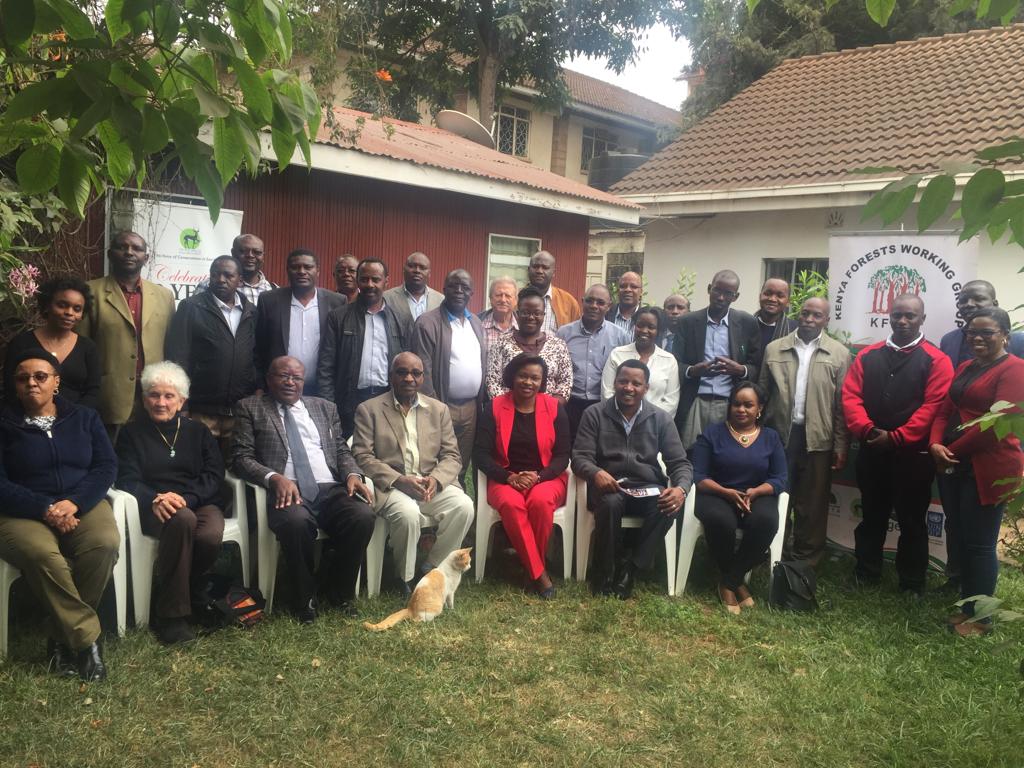
KFWG is probably the most influential lobby group in the cause of forest conservation in Kenya. KFWG strongest function has been providing a watchdog role through its forest monitoring activities and related advocacy actions, as well as influencing policy and preparing communities for participatory forest management.
KFWG was formed in 1995 as a forum of individuals, organizations and institutions (government and non government, local and international) and community organizations concerned with forests, working together to promote sound forest management and conservation practices in Kenya. Its mission is to promote sustainable forest management in Kenya through research, advocacy, networking and partnerships development for improved livelihoods for all Kenyans. Its strongest function is to provide a watchdog role through its forest monitoring activities and related advocacy actions, as well as influencing policy and preparing communities for participatory forest management.
Activities currently being undertaken by the Kenya Forests Working Group (KFWG)
Advocacy
Emerging forest issues
- Jointly with the Timber Manufacturers Association, lobbying for the review/ lifting of the logging ban imposed by the Government in1999. However, three companies have been exempted from the ban (Rai Plywood, Timsales and Webuye Paper Mills).
- Tackling a new wave of forest destruction, through forest status monitoring and media advocacy.
- Advocating against the mad rush for biofuels at the expense of indigenous forest cover, and blanket condemnation of eucalyptus (have supported production of a guide on eucalyptus production)
- Exploring ways to contest or express disappointment regarding composition of KFS Board (No Civisl Society Orgnanisation – CSO- representative)
Forest sector reforms
Since the enactment of the Forests Act 2005 in 2007, the government has embarked on forest sector reforms. Under this reforms, KFWG is:
- Supporting formation and operationalisation of Community Forest Associations (CFAs) which will enter into joint management agreements with the Government (KFS) under the new Participatory Forest Management (PFM) arrangements.
- Partnering with KFS in implementing Miti Mingi Maisha Bora Project (MMMBP)-KFWG is on the Steering Committee, key role currently is planning for project implementation. Expound on MMMBP. MMMB is a 5year GoK/Finnish Embassy supported program supporting Kenyas Forest sector reform process. Its overall objective is “A reduction in poverty through ensuring that the forest sector contributes effectively and sustainably to improving the lives of the poor, restoring the environment, and aiding the economic recovery and growth ofKenya, within the context of Vision 2030’.
- Strengthening devolved governance structures, planning to facilitate a meeting on corporate governance for the KFS Board.
- Assisting KFS, by supporting implementation of its communication strategy.
- Supporting implementation of the Forests Act 2005 by facilitating development of, and lobbying for the gazettment of subsidiary legislation
Forest policy
Jointly with Timber Manufacturers Association, through media advocacy, lobbying for finalization and endorsement of Forest Policy which is yet to be adopted by the Government.
Participatory Forest Management (PFM)
- Jointly with KFS, and other partners, KFWG is supporting PFM process through development of Forest Management Plans and agreements, and training CFAs on PFM (Negotiation, Leadership, governance, conflict management)
- The management plans we have successfully facilitated the development include Dundori Forest, Bahati Forest and Maasai Mau Forest. Next steps entail developing management agreements between KFS and CFAs
- The next management plan we will be assisting its development is for Wire Forest- Rachyuonyo.
- Creating awareness on gazetted subsidiary legislations through posters, workshops and community meetings
Information sharing
- Maintaining an updated website for information sharing
- Organizing forums such as KFWG monthly meetings, workshops and village meetings for information sharing
- Has produced posters to sensitize stakeholders on subsidiary legislation
Monitoring
- Have organized a series of fact finding missions to selected forest hot spots jointly with journalists to highlight destruction and engage with the relevant authorities for remedial action.
- We are compiling a documentary that will serve as an advocacy tool.
- Among forests visited are Eburu, Shamanek, Mt. Elgon, Cherengany, Kinale and Kijabe strip Forest.
Capacity building
On 26th May 2010, organized a training for KFWG members on remote sensing. This was facilitated by the Endeleo Project team based in Belgium. Endeleo is a partnership project that facilitates access to satellite data to enable resource managers to better understand and monitor their environment and its dynamics over time. Key project partners are UNEP, DRSRS, RCMRD, the University of Ghent and the Flemish Institute for Technological Research (VITO)
- Have lined up capacity building activities targeting KFS Board, Forest Conservation Committees and CFAs
- Through the MMMB Project we anticipate to play an active role in building the capacity of CFAs
- Are playing an active role in supporting PFM processes (development of management plans and agreements )
Awareness
Awareness activities we are undertaking mainly relate to PFM process and the wider forest sector reform, especially as relates to subsidiary legislation
Partnership building
We have initiated processes aimed at initiating and /or strengthening strategic partnerships with key partners. Among them include the youth in Universities, Green Africa Foundation, ICRAF, YES Youth Can, and the Kenya Climate Change Working Group. KFWG key achievements to date
Achievements
The following are some of the achievements of KFWG
- Support to Forest Act 2005 Implementation. KFWG, in partnership with KFS has (a) facilitated the process of operationalizing Forest Conservation Committees (FCC) and Community Forest Associations (CFAs). Key activities entailed overseeing the process of CFA representation to FCC, and inducting FCC members, and strengthening CFAs through training and sensitization as well as strengthening CFA networking capacity through supporting formation of Conservancy Umbrella Forums (CUFs); (b) tracking the progress of Forest Act implementation by regularly updating the Policy Action Matrix and disseminating information on the same via the website www.policyactionmatrix.org (c) prepared policy briefs to critique, inform, and advocate for paced up implementation of forest sector reform process.
- Established an award scheme. KFWG jointly with the Green Africa Foundation has set up the ‘Green Award’ to recognize exemplary performance within the Environment Sector. A committee to manage the scheme is in place. Resource mobilization is underway. Already a trophy and bicycles donation has been received and awarded.
- Monitoring of Forest Status. KFWG has conducted rapid assessment surveys and used findings to lobby decision makers to take remedial measures. Findings have been analyzed and used to document advocacy materials, that include a video documentary and a leaflet called ‘the Forest Microscope’.
- Awareness. Popularised the need and benefits of sound forest management and conservation to the public through radio programmes, newspapers, posters, KFWG newsletter, billboards, seminars, public meetings, etc.
- Karura Forest. KFWG successfully facilitated the initiation and mobilisation of Nairobi residents to protest against illegal allocation of Karura forest in 1998. Forest clearing for development of housing estates came to a stop.
- Oloolua Road Forest. KFWG facilitated meetings between government and Karen Langata District Association in order for the latter to air their concern over the destruction of Oloolua Forest resulting from excavation for building stone. The outcome was the ban on stone mining in October 1999 after conclusion of an Environmental Impact Assessment exercise.
- Arabuko Sokoke Forest. Dialogue between KFWG and government officials led to the halting of a proposal to allocate 5,000 hectares of Arabuko-Sokoke Forest in 1997.
- Ngong Road Forest. Meetings facilitated by KFWG between government officials and Ngong Road Forest Sanctuary Trust led to acquisition of forestland given out for private development and issuing of a title deed for the Ngong Road Forest Sanctuary in 1999. The Ngong Road Forest Sanctuary Trust through a memorandum of understanding with the Forest Department is managing the sanctuary. A business plan to guide the management was launched on 29th March 2001.
- Mt. Kenya forests. With support from the Kenya Wildlife Service, KFWG managed to have an Aerial Assessment of the destruction of Mt. Kenya forests done in 1999. Following the publicity and implementation of some of the findings of the survey in 1999, the status of the Mt. Kenya forests has improved as revealed by the aerial survey of 2002 and the forest cover changes report (2000 – 2003) that is based on analysis of satellite images by KFWG and the Department for Resource Survey and Remote Sensing (DRSRS) with technical support from UNEP.
- The Aberdares Range forest. In partnership with UNEP, KWS and Rhino conducted a comprehensive aerial survey of the status of the Aberdares Range forests. The report, launched in June 2003, provides useful information and recommendations for future conservation of the Aberdares.
- Participatory forest management plans. KFWG has facilitated a participatory process that led to drawing participatory forest management plans for Bahati, Dundori, Maasai Mau, Mt. Kenya, Rumuruti, Eburru, Kereita, Ngangao and Kitobo forest areas. All have been approved by KFS.
- Input in policy and legislation. KFWG provided input to the drawing up of the new Forests Act 2005, Draft Forest Policy, Forest rules and regulations and the Environmental Management and Co-ordination Act 1999.
- Excision of 67,000 ha of forestland (Kenya Gazette Notice of 19th October 2001). KFWG provided information on status of the areas excised that was based on aerial surveys and satellite images to the public and government institutions. KFWG in 2002 launched a campaign against the excisions which led a stop in further forest excisions.
- Forest cover changes of the “five water towers”. KFWG and DRSRS with technical support from UNEP monitored the status of the five water towers (Mt. Kenya, Aberdares, Cherangani, Mau and Mt. Elgon forests) using satellite images. Reports for the period between 2000 and 2003, 2003 and 2005 and 2000 and 2007 were prepared and launched. The analysis that aimed at providing concerned stakeholders with an early warning system enabled the identification of threatened forest areas in time and allowed for prioritisation of interventions in these areas to reverse detrimental forest cover changes.
- Mau Forest Campaign. KFWG undertook an aerial point sampling for the Eastern and South Western Mau Forests aimed at rationalizing settlements in Mau and an aerial survey for the Maasai Mau Forest as a base for sustainable management of the forest. The campaign mostly targeting the Mau Complex Forest was later launched in 2005. The campaign led to the formation of the Mau Task Force and creation of an Interim Coordinating Secretariat (ICS) to coordinate the implementation of the Task Force recommendations.
- Capacity Building in Participatory Forest Management (PFM). KFWG provides technical expertise to emerging forest association through training and exchange visits. A training package for the associations has been formed to guide training. KFWG is also involved in resolution of natural resources management conflicts and monitoring implementation of PFM.
For more information, please visit the KFWG website www.kenyaforests.org.
|